Wolf-shifter romance works best when the supernatural premise changes the relationship instead of merely decorating it. This guide focuses on books where pack structure, secrecy, transformation, territory, or mate bonds meaningfully shape the story.
Affiliate disclosure: As an Amazon Associate I earn from qualifying purchases. If you buy through an Amazon link in this guide, Fiction Found Here may earn a commission at no extra cost to you. Full disclosure.
A strong pick for readers who want pack politics, a richly developed paranormal world, and a newly forming mate bond tested by dangers beyond the couple.
Rainmark Wolves uses a specific variation on fated mates: recognition can be supernatural, but the relationship still has to be chosen. Grant recognizes Mira before she even knows wolves exist, making information, trust, and adult choice central to the romance.
Which kind of wolf-shifter romance should you choose?
Choose pack-focused romance for social stakes
If you want the supernatural world to matter beyond attraction, prioritize books where pack membership, rank, territory, leadership, exile, or community expectations create real consequences. Feral Sins, The Tyrant Alpha’s Rejected Mate, and Cry Wolf all use pack structure differently, but each gives the relationship a social context larger than the couple.
Choose hidden-world romance for discovery
If you prefer learning the supernatural rules alongside a protagonist, look for stories where the heroine enters or uncovers a shifter community gradually. Cold Hearted emphasizes place and belonging, while What Fate Can’t Choose uses a human professional discovering a hidden pack during an external emergency. That structure can make revelation, information, and consent as important as attraction.
Choose fated or rejected mates for relationship pressure
Mate-bond stories vary widely. Some treat recognition as near-certainty; others use it as a source of conflict that the couple must interpret. Rejected-mate books add another layer because the bond may exist while trust has already been damaged. If this is your preferred lane, pay attention to whether the story gives the heroine meaningful choices after recognition and whether repair requires changed behavior rather than destiny alone.
Before choosing a wolf-shifter romance
Check which part of the shifter premise you actually want emphasized. Some books foreground pack hierarchy and territorial politics; others are relationship-first stories where shifting mainly intensifies attraction and belonging. Fated-mate books can also handle choice very differently, from immediate certainty to bonds that create pressure without resolving trust or compatibility. If heroine agency matters to you, look for a protagonist with goals, work, relationships, or supernatural competence that remain relevant after the romance begins. Heat level, rejected-mate conflict, omegaverse elements, violence, and pack power structures also vary substantially between titles, so an author’s current content notes are the best source when a specific element affects your reading choice.
Frequently asked questions
What is a wolf-shifter romance?
It is a paranormal romance where one or more central characters can transform into wolves or belong to a werewolf/shifter society. Pack rules, secrecy, territory, and supernatural relationship customs often shape the plot.
Do all wolf-shifter romances use fated mates?
No. Some use destiny-style bonds, while others build the romance through attraction, pack politics, investigation, friendship, or forced proximity.
Where should a new reader start?
For classic pack dynamics, start with Feral Sins. For a lighter contemporary tone, try Wolf Gone Wild. For FFH’s choice-centered take on fated mates, try What Fate Can’t Choose.
Cozy fantasy is not one exact formula. Some books are almost slice-of-life. Others have mysteries, journeys, political trouble, magical danger, or romance running beneath the comfort. What unites the shelf is the promise that the story will spend more energy on belonging, community, recovery, craft, food, friendship, home, or meaningful everyday problems than on relentless violence and catastrophe.
That range matters. A reader who loves the pure shop-building comfort of Legends & Lattes may want something different from a reader who likes cozy atmosphere but still needs a substantial external plot.
This list mixes the modern genre-defining titles with books that stretch cozy fantasy toward mystery, journey, romance, and practical problem-solving.
Looking for the romantic side of cozy fantasy without explicit scenes? Our guide to cozy fantasy with romance but little or no spice separates closed-door, kisses-only, and low-spice recommendations so you can choose a book that fits your comfort level.
Affiliate disclosure: As an Amazon Associate I earn from qualifying purchases. If you buy through an Amazon link in this guide, Fiction Found Here may earn a commission at no extra cost to you. Full disclosure.
Editorial disclosure: Fiction Found Here publishes The Lockkeeper of Alder Reach by Elodie Fenwick. You can also explore The Waters of Lowsend series page. It is clearly labeled below and included because it fits the cozy-fantasy market while deliberately offering more external plot and practical stakes than some slice-of-life entries.
Competence, waterways, community systems, and concrete stakes
14 cozy fantasy books worth reading in 2026
1. Legends & Lattes by Travis Baldree
A retired orc adventurer opens a coffee shop in a city that barely understands coffee. The pleasure comes from building something: a business, a routine, a menu, friendships, and eventually a community.
Kiela is a librarian forced to flee when revolution destroys the Great Library. She returns to her childhood island with forbidden spellbooks, a sentient spider plant, and very little desire to deal with people. What follows combines rebuilding, jam-making, illegal magic, community, and romance.
3. The Very Secret Society of Irregular Witches by Sangu Mandanna
Mika Moon has spent years keeping her witchcraft isolated. An invitation to teach three young witches at a remote house changes that. The core appeal is belonging: she enters a strange household and slowly discovers the possibility of family and love.
Tao travels from village to village telling deliberately small fortunes because she knows big predictions can carry big consequences. A seemingly minor fortune pulls her into a search for a missing child, and companions accumulate around her along the way.
A tea monk meets a robot in a future where robots left human society generations ago. The book is short, reflective, and built around questions of purpose, enoughness, work, and what people actually need.
6. Can’t Spell Treason Without Tea by Rebecca Thorne
A queen’s guard and a powerful mage leave dangerous careers behind to open a tea-and-book shop together. Leaving does not mean their old world stops existing.
Set earlier in Viv’s life, this companion to Legends & Lattes shifts from building a coffee shop to recovering in a small town, discovering a bookshop, and learning how to live at a slower pace than adventuring usually allows.
A rule-bound caseworker is sent to inspect an unusual home for magical children. The emotional engine is the gradual dismantling of his bureaucratic assumptions and the possibility that a strange household can become home.
A return to the world connected to The Spellshop, with the same broad appeal to readers who like magical domesticity, unusual plants, food, community, and romance.
For readers already invested in the world of The House in the Cerulean Sea, this continues the emotional investment in magical children, family, belonging, and the institutions that shape their lives.
14. The Lockkeeper of Alder Reach by Elodie Fenwick — Fiction Found Here
A practical lockkeeper in a canal-centered community faces a problem that cannot be solved by simply brewing tea and waiting for everyone to feel better. The book keeps the warmth, competence, community, and restorative atmosphere of cozy fantasy while giving the protagonist a real external problem with consequences for other people.
Editorial disclosure: Fiction Found Here publishes this title. Learn more about the series on The Waters of Lowsend.
What actually counts as cozy fantasy?
There is no single official rulebook. In practice, readers tend to expect some combination of lower stress than epic or grimdark fantasy, community and belonging, found family, starting over or rebuilding, food or books or craft, hopeful emotional payoff, and a world worth spending quiet time inside.
Low stakes does not have to mean no plot. For many readers, the sweet spot is a story with meaningful external problems while the overall emotional contract remains hopeful rather than relentlessly stressful.
How to choose a cozy fantasy book
Choose shop-building or domestic fantasy if routines, food, books, craft, and community are the main comfort you want.
Choose cozy fantasy with more plot if you still want an investigation, journey, practical problem, or external objective moving the story forward.
Choose romance-forward cozy fantasy when the relationship is part of the emotional payoff you want repeated.
Choose older or established protagonists if second acts, work, competence, and adult life experience matter more than coming-of-age.
Frequently asked questions
What is cozy fantasy?
Cozy fantasy generally emphasizes comfort, community, hope, everyday competence, and emotionally restorative stakes more than relentless violence or catastrophe. Some books are almost slice-of-life; others still include mysteries, journeys, romance, or practical external problems.
What is a good cozy fantasy book to start with?
Legends & Lattes is a strong gateway if you want the genre’s shop-building and found-family side. The Spellshop works well if you want more magic and romance, while The Lockkeeper of Alder Reach is designed for readers who want cozy atmosphere plus a substantial external plot.
Does cozy fantasy have to be low stakes?
No. Many readers use “cozy” to describe the emotional experience rather than the total absence of consequences. A story can contain real problems or danger while remaining hopeful, community-centered, and comparatively low-stress.
Are cozy fantasy books always romances?
No. Romance is common, but cozy fantasy can center friendship, found family, work, community, recovery, travel, craft, food, books, or personal reinvention instead.
Editorial disclosure: Fiction Found Here publishes What Fate Can’t Choose by Talia Lorne. It is included because the pack functions as a community with responsibilities, secrecy, territory, and regional consequences rather than as decorative paranormal scenery.
Wolf-shifter romance works best when the pack feels like more than a collection of attractive supernatural men. Hierarchy should create obligations. Territory should matter. Shifting should affect how characters move through the world. Pack rules should create both safety and conflict.
The books below use werewolf or wolf-shifter worldbuilding in materially different ways, but each gives the supernatural community a role in the plot rather than treating the wolf side as a cosmetic label.
Quick picks
If you want…
Start with…
Modern pack responsibility + adult emergency stakes
Pack-world appeal: hidden-community responsibility, regional emergency management, territory, secrecy, and an Alpha whose role has practical obligations.
Assistant Emergency Manager Mira Danner meets Grant Morlan during a prolonged Oregon rain emergency and landslide evacuation. Grant is not simply “the Alpha” as a romantic title. His pack has land, people, secrecy, and regional responsibilities that continue regardless of what happens between him and Mira.
The fated-mate bond creates pressure, but the relationship still has to survive ordinary adult questions: trust, consent, compatibility, work, and whether Mira wants a place in this hidden world at all.
Pack-world appeal: werewolf hierarchy, the Marrok’s authority, internal pack damage, mate recognition, and a supernatural threat outside the relationship.
Anna has spent years at the bottom of an abusive pack before Charles Cornick arrives and recognizes that she is an Omega. The first novel then moves into the Montana wilderness, where the pair must deal with a rogue-wolf threat and forces that put the wider pack at risk.
Pack-world appeal: a wolf society built around survival, hierarchy, land, ritual, and a worldview that does not simply map human assumptions onto supernatural characters.
Silver is at the bottom of the Great North Pack’s social order when a wounded stranger arrives in pack territory. The external danger threatens not just the couple but the pack’s land and survival, making community structure central to the romance.
4. The Tyrant Alpha’s Rejected Mate by Cate C. Wells
Pack-world appeal: restrictive hierarchy, rejected-mate consequences, pack status, and a heroine building independence inside a system that undervalues her.
Una has learned to survive near the bottom of a pack where female wolves rank low and her physical differences make her easy to dismiss. When she recognizes Alpha Killian as her mate and he rejects her publicly, the bond becomes a political and social problem as much as a romantic one.
Una’s hidden farmer’s-market business is also important: it gives her a sphere of competence and community that does not depend on the Alpha.
Pack-world appeal: outcast status, true-mate expectations, punishment by the pack, and a supernatural hierarchy that expands beyond ordinary wolf politics.
Mera grows up inside a powerful shifter pack after her father’s betrayal turns her into a target. Her first shift is expected to reveal her true mate, but the result does not deliver the safe future she imagined.
The Shadow Beast Shifters trilogy has renewed visibility through Harlequin’s current deluxe paperback editions, with Reclaimed and Reborn reissued in 2026.
Pack-world appeal: the SnowDancer wolf pack functions as a political, military, and emotional community rather than mere romantic scenery.
Sienna Lauren has defected from the PsyNet and lives among the SnowDancers, while Hawke carries the responsibilities of an Alpha during escalating conflict. The external threat to the pack makes the romance inseparable from larger questions of loyalty and survival.
Pack-world appeal: Lykae clan identity, predestined mates, longstanding supernatural conflict, and a much larger paranormal society.
Lachlain MacRieve is leader of the Lykae Clan and recognizes Emmaline as his predestined mate after centuries of captivity. The book is a foundational fated-mates paranormal romance, but readers should expect a more coercive early dynamic than many newer mate-bond romances use.
Pack-world appeal: wolf instinct and supernatural identity matter directly to the romantic problem even though the book is more couple-focused than pack-political.
Mateo Cruz has been unable to shift for months, leaving his wolf trapped in his head and increasingly difficult to control. He turns to witch Evie Savoie for help, crossing supernatural-community boundaries in the process.
Pack-world appeal: the novella that establishes Anna, Charles, the Chicago pack conflict, and Anna’s rare Omega role before Cry Wolf.
If you care most about how hierarchy works, begin here before the first full novel. Anna’s position inside an abusive pack and Charles’s arrival change the power structure before the larger Alpha and Omega series begins.
The pack has functions. Leadership should involve work, not merely dominance.
Territory creates consequences. Land, secrecy, neighbors, enemies, and resources should matter.
Hierarchy should affect ordinary life. Rank is more convincing when it changes obligations, protection, access, and conflict.
Shifting should alter the plot. Senses, mobility, healing, instinct, or physical limits should create options and problems.
The heroine needs a relationship to the pack. Joining, rejecting, reforming, surviving, or negotiating with the community should be a meaningful choice.
Editorial disclosure: Fiction Found Here publishes Violent Terms by Sloane Daire. It is included because the criminal ecosystem is designed to keep moving independently of the romance.
Organized-crime romance works differently when the underworld is more than an aesthetic. Alliances should create obligations. Territory should matter. Violence should have strategic consequences. Rivals should have motives that exist whether the couple is kissing or fighting.
The books below all use criminal organizations, mafia families, mob politics, assassins, conspiracies, or underworld mysteries as more than background decoration. The balance varies—some are romance-first, some lean hard into suspense—but each gives the external plot something meaningful to do.
External engine: a criminal compact approaching renewal while somebody uses violence to fracture the alliance.
The central marriage is strategic, but it is not the whole plot. Avenport’s criminal economy has power blocs, territory, money, institutional memory, and an agreement whose failure would affect far more than the featured couple.
That means the romance and suspense pressure each other. Trust changes what information can be shared; attraction changes what leverage means; and every private decision can create public consequences.
External engine: a twenty-year mystery inside a criminal organization.
The official Dark Verse description pairs Tristan Caine, an anomaly inside the Tenebrae Outfit, with Morana Vitalio, the technologically gifted daughter of a rival family. Their hostility is only one part of the story because a larger pattern involving missing girls and buried history keeps expanding.
External engine: a marriage pact intended to prevent war between two criminal families.
The romance begins because the Griffin and Gallo conflict has become strategically dangerous. That gives every fight between Aida and Callum a second layer: if the arrangement collapses, the consequences reach their families and organizations.
External engine: an assassin is targeting Riona Griffin.
The protection setup is not just a reason to put two people in the same room. Somebody is actively trying to kill the heroine, which gives the relationship a continuing investigative and tactical problem.
External engine: a long-unsolved disappearance colliding with mafia secrets.
Natalie’s fiancé vanished years earlier. The dangerous stranger who enters her life is connected to a criminal world that changes the meaning of that disappearance. The romance therefore develops alongside a mystery rather than replacing it.
External engine: enemy criminal empires joined through marriage.
The official description centers an Irish mobster and an Italian mafia princess whose marriage ties together rival power structures. That political arrangement keeps the stakes outside the bedroom even as the relationship becomes the emotional center.
External engine: criminal power, hidden identity, and the dangerous household surrounding Adrian Volkov.
This trilogy is darker and more psychologically coercive than several other recommendations here. The heroine is asked to impersonate a dead wife, and the mystery of why that role matters becomes inseparable from the danger around Adrian.
External engine: mafia politics surrounding a fake marriage.
Neva Altaj’s Perfectly Imperfect series is explicitly set across Italian and Russian mafia worlds. Painted Scars combines a fake-marriage romance with the larger criminal structure that Roman belongs to, while later standalones keep building that interconnected ecosystem.
External engine: a marriage designed to secure peace between powerful mafia families.
Aria Scuderi is promised to Luca Vitiello as part of an inter-family alliance. The relationship cannot be separated from the politics of the organizations around them, because the marriage itself is a diplomatic instrument.
Editorial disclosure: Fiction Found Here publishes Morrow Cut by Avery Rooke. It appears below because it is specifically built around an established adult professional learning to use a progression system.
Progression fantasy often begins with a young protagonist at the bottom of a power ladder. That structure works, but it is not the only way to tell a satisfying weak-to-strong story. Adult protagonists bring different pressures: jobs, habits, prior competence, moral responsibility, damaged assumptions, and a life that already existed before the System or magic changed everything.
The books below are useful if you want visible growth without defaulting to a school-age coming-of-age arc.
Best for: readers who want an adult female protagonist whose existing professional skills shape her progression.
Kira Rennick is an air traffic controller before she is stranded inside a fractured fantasy frontier. She does not arrive with sword mastery or a heroic destiny. What she has is years of training in sequencing movement, prioritizing risk, maintaining situational awareness, and handing specialized work to the right people.
The System turns those habits into a control-oriented Path. Progression matters because each new capability changes what Kira can coordinate, anchor, move, or protect—not because a stat number rises in isolation.
Best for: adult survival, tactical problem-solving, dark comedy, and a game system that keeps changing the rules.
Carl is a Coast Guard veteran when Earth is transformed into a lethal intergalactic game show. The dungeon gives him levels, loot, classes, and absurd mechanics, but his adult experience matters just as much as the numbers. He has to improvise under pressure, protect others, understand an adversarial system, and survive while millions watch.
Best for: an outspoken adult protagonist, deep ability design, worldbuilding, humor, and long-form progression.
Jason Asano is transported into another world and gains powers through a system that blends cultivation with LitRPG-style advancement. The series gives him a strong preexisting personality instead of treating him as an empty player avatar, which creates as much friction as his powers solve.
Best for: System apocalypse, huge-scale cultivation, class and skill choices, and relentless advancement.
Zac is alone in the wilderness when Earth is integrated into a multiverse governed by a System. He has to survive monsters, build power, locate his family, and eventually navigate a setting where progression extends far beyond simple levels.
The series is especially useful if you want adult survival pressure combined with an enormous long-term power ladder.
Best for: an experienced loner, System mechanics, survival competence, and a protagonist who is already powerful when the main story begins.
Derek has already survived years of System integration on Earth when an intervention throws him into another System entirely. That makes the setup different from a blank-slate tutorial: he arrives with habits, combat experience, and assumptions that no longer fit perfectly.
Best for: System apocalypse, solo progression, archery, crafting, and a protagonist comfortable making his own choices.
Jake begins as an adult office worker before the world is transformed by a game-like System. The series quickly leans into his independence, build choices, hunting instincts, and willingness to pursue a path that does not always match what other people want from him.
Best for: progression fantasy that deliberately rejects the usual climb-to-the-top lifestyle.
The protagonist wakes in the body of a cultivator and promptly decides he wants no part of arrogant masters, endless duels, or suicidal ambition. Farming becomes the center of his new life—except cultivation, talking animals, community, and consequences keep making that supposedly quiet choice much more interesting.
Best for: noncombat progression, classes and levels, enormous worldbuilding, and ordinary work becoming consequential.
Erin Solstice is transported into another world and becomes an [Innkeeper]. Her progression is not built around becoming the strongest fighter. Running an inn, building relationships, surviving local dangers, and gaining class abilities gradually connect her to events much larger than the building itself.
Best for: deck-building progression, skill acquisition, careful build construction, and readers who want mechanics that differ from standard attribute sheets.
Arthur receives a powerful Master of Skills card in a world where magical cards define opportunity and danger. The system emphasizes acquiring, combining, and exploiting skills rather than simply watching a small set of attributes climb.
Existing competence matters. The protagonist can transfer real skills instead of starting as a total blank slate.
Responsibility changes power. Advancement may create obligations to coworkers, communities, families, or people who depend on the protagonist.
Identity is already formed. The interesting question becomes how power changes an adult worldview rather than simply who the character will grow up to be.
Failure has a different texture. An adult protagonist can know exactly what competent behavior looks like and still discover that a new world invalidates part of that expertise.
Editorial disclosure: Fiction Found Here publishes The Line No Map Shows by Natalie Verran. It is included because its core promise is procedural: evidence, records, interviews, timelines, and the practical limits of police work.
A police procedural becomes satisfying when the case advances because investigators do the work: they preserve scenes, compare statements, identify what records can and cannot prove, obtain warrants, revisit timelines, and turn disconnected facts into an explanation that survives scrutiny.
This list favors books and series where that process matters. Some are more thriller-heavy than others, but none depend entirely on a detective making a lucky guess in the final chapter.
Why it fits: the homicide solution depends on ordinary investigative tools used carefully.
When a land surveyor is murdered beside a disputed development, Lena Wardell and the Ashby County Major Crimes team have to determine which facts are actually relevant. Measurements, property history, witness accounts, documents, physical evidence, and motive do not line up neatly at first.
The case is built around a practical procedural question: what can the investigators prove, and what only looks persuasive until the evidence is tested?
Why it fits: regional setting and patient investigation are both central.
The Vera Stanhope series is a useful benchmark for readers who want police work embedded in a specific landscape and community. Vera’s investigations rely on observation, interviews, inconsistencies, and the social knowledge surrounding a crime rather than spectacle alone.
Why it fits: police bureaucracy, assignment, shift structure, and investigative persistence shape Renée Ballard’s work.
Connelly’s crime fiction is particularly useful for readers who want law enforcement to feel like an institution rather than a loose collection of action heroes. Ballard’s cases unfold inside hierarchy, procedure, competing priorities, and the limits of what one detective can control.
Why it fits: old evidence and old assumptions have to be re-evaluated when a case remains unresolved.
Cold cases are procedural stories about evidence over time. What was preserved? What was missed? Which statements changed because memory changed, and which changed because somebody lied? Karen Pirie’s world is a strong fit if those questions interest you more than chase scenes.
Why it fits: the Maeve Kerrigan series combines police-team continuity with case-specific investigations.
Workplace dynamics matter, but they do not replace the case. The books make room for the ordinary friction of policing—colleagues, supervisors, assumptions, witness management, and the need to justify conclusions.
Why it fits: police investigation and forensic medicine interact rather than existing as separate decorative specialties.
The Rizzoli & Isles books are darker and more thriller-oriented than the quietest procedurals, but readers who like evidence-based investigation often appreciate how medical information changes what the police can infer.
Why it fits: Erika Foster’s investigation develops through victim history, interviews, evidence, and competing explanations.
This is a faster, more commercial crime-thriller version of the procedural, useful for readers who want the police-work engine but prefer stronger cliffhangers and higher narrative velocity.
Why it fits: Kim Stone’s team structure and long-running professional continuity support case-driven plots.
The series is darker than Lena Wardell or Vera Stanhope, but it still offers the pleasure of detectives working together, testing hypotheses, and following evidence through a complete investigation.
9. Vanishing Girls by Lisa Regan
Why it fits: contemporary small-city policing and recurring team relationships sit inside a fast procedural-thriller structure.
Josie Quinn is a strong option when you want a large backlist, rapid pacing, and cases where the investigator remains the narrative center.
Why it fits: police procedure and psychological suspense are tightly combined.
The Lacey Flint series is more intense than a traditional restrained procedural, but it remains rooted in a recurring police protagonist and cases that demand actual investigation.
What makes a police procedural feel realistic?
Evidence has limits. A record should answer one question, not every question.
Investigators need legal authority. Access to private places and records should not appear magically.
Forensics are useful, not omniscient. Laboratory evidence should narrow possibilities rather than instantly solve everything.
Witnesses are imperfect. Honest people can be mistaken without becoming plot cheats.
Cases require prioritization. Detectives cannot pursue every possible lead with unlimited time and staff.
What is the difference between a police procedural and a crime thriller?
A police procedural foregrounds the methods and constraints of investigation. A crime thriller may use police characters but prioritize danger, pursuit, conspiracy, or suspense over the mechanics of building a case. Many books combine both.
Which books here are best if I want less serial-killer spectacle?
Start with The Line No Map Shows, the Vera Stanhope series, Karen Pirie, or Maeve Kerrigan.
Editorial disclosure: Fiction Found Here publishes The Line No Map Shows by Natalie Verran. It is included because it fits this guide’s focus on female-led, evidence-driven detective fiction.
If your favorite mystery novels are the ones where the detective work itself is the attraction, a recurring investigator can be more satisfying than a one-off thriller. You get continuity of character and place while each new case creates a fresh evidentiary problem.
This list leans toward female detectives, police investigators, and crime-series protagonists whose cases move through interviews, records, forensic limits, timelines, warrants, witness contradictions, and the slow assembly of proof. Some books are darker or more thriller-forward than others, but each gives investigation a central role.
Lena Wardell is built for readers who want the case to progress because investigators gather and test evidence rather than because the killer keeps escalating spectacle. In the first book, the murder of a land surveyor draws Lena into a dispute where measurements, property records, physical evidence, and motive point in different directions.
The series is regional rather than metropolitan, so place matters without replacing the investigation. Each case is designed to resolve inside its own book while Lena, her Major Crimes team, and Ashby County continue across the series.
Vera Stanhope is one of the clearest choices for readers who want a strong recurring female detective, regional atmosphere, and cases rooted in place and human relationships rather than nonstop action. The Northumberland setting is part of the series identity, but the books remain investigation-driven.
Karen Pirie works especially well for readers who like cold cases, old evidence reinterpreted through new information, and investigations where time changes what witnesses remember and what can still be proved.
Ballard’s Los Angeles setting brings police bureaucracy, shift work, jurisdiction, and career pressure directly into the crime-solving engine. The appeal is not just that Ballard is capable; it is that her work exists inside an institution with limits and consequences.
Maeve Kerrigan develops across a long-running London police series where workplace dynamics, investigative procedure, and the changing professional relationships around the unit matter from book to book.
Josie Quinn is a good fit for readers who prefer fast-moving, contemporary police investigations and want a large backlist to continue into. The series mixes procedural work with personal continuity across cases.
Erika Foster’s books sit closer to crime thriller territory, but the recurring appeal is the investigation: a detective pursuing evidence through interviews, victim history, forensic information, and institutional friction.
Kim Stone is another strong option for readers who want a long-running police series with a clear investigative engine and team continuity. The books often carry darker subject matter, so they are a better fit for readers comfortable with a more intense crime-thriller register.
9. Jane Rizzoli by Tess Gerritsen
Start with:The Surgeon
The Rizzoli & Isles books combine police work with medical and forensic detail. They are more thriller-forward than some of the slower procedural series here, but they remain useful if you want a recurring female detective whose cases depend on evidence and investigative persistence.
Lacey Flint is a strong pick for readers who want darker suspense and psychological pressure while still following a recurring female police protagonist. The cases lean toward thriller intensity rather than quiet proceduralism.
How to choose the right female detective series
For regional atmosphere + careful police work: Lena Wardell or Vera Stanhope.
For cold cases: Karen Pirie.
For metropolitan institutional pressure: Renée Ballard or Maeve Kerrigan.
For faster crime-thriller pacing: Josie Quinn, Erika Foster, Kim Stone, or Lacey Flint.
A strong series gives the investigator a continuing professional and personal world while letting each case introduce a genuinely new problem. The detective should not need to become less competent simply to create suspense.
Which series is best if I want evidence and procedure?
Start with Lena Wardell, Vera Stanhope, Karen Pirie, Renée Ballard, or Maeve Kerrigan. All place substantial weight on investigation rather than treating police work as background scenery.
Cozy fantasy does not have to mean a book where almost nothing happens. Plenty of readers want the genre’s warmth, found family, practical magic, and emotional safety while still expecting a concrete problem to solve, a journey to complete, a mystery to untangle, or a community that has to change.
This guide is for that reader. The books below keep the restorative appeal of cozy fantasy but add enough external movement to create momentum. Some are more adventurous than others, but each gives the characters something meaningful to do beyond settling into a pleasant setting.
A witch becomes responsible for teaching three young witches while protecting their unusual household.
1. The Lockkeeper of Alder Reach by Elodie Fenwick
Best for: readers who want cozy fantasy built around adult competence, practical magic, infrastructure, and a real external problem.
Senior lockkeeper Tilda Renn lives in Lowsend, a terraced canal city where magic moves through the water network. When a conservation program she helped approve destabilizes how that magic reaches the city, the story becomes a cause-and-effect investigation rather than a purely atmospheric stay in a charming place.
The cozy contract comes from community, useful work, restrained romance, and a world designed to feel livable. The forward motion comes from engineering logic, institutional decisions, and a problem that has to be solved cleanly.
Best for: conservation stakes, magical creatures, workplace competence, and a sapphic romance.
Set inside a magical zoo, The Phoenix Keeper centers on Aila, a keeper trying to restore a failing endangered-phoenix breeding program. That gives the book an unusually concrete professional objective for a cozy fantasy: the creatures, facilities, public support, and conservation work all matter.
The result is warm and romantic without abandoning causality. The endangered species problem is not decoration; it is the engine that forces Aila to take risks and work with people she would rather avoid.
3. Can’t Spell Treason Without Tea by Rebecca Thorne
Best for: readers who like the business-building comfort of Legends & Lattes but want more adventure around it.
Reyna and Kianthe want a quiet bookshop serving tea, but one is a former royal guard and the other an extremely powerful mage. Their attempt to leave their old responsibilities behind creates a cozy homebase while dragons, mysteries, and a murderous queen keep the story moving.
Best for: cottagecore, magical books, rebuilding a life, and gentle romance with an actual external disruption.
Kiela is a librarian whose protected life disappears when revolution reaches the Great Library. She escapes with spellbooks and returns to the island where she grew up, trying to survive while using magic that is not supposed to be available to ordinary people.
It is intentionally cozy, but the opening catastrophe and the illegality of what Kiela is doing give the book more narrative pressure than a simple slice-of-life premise.
5. The Very Secret Society of Irregular Witches by Sangu Mandanna
Best for: found family, hidden magic, romance, and a household that needs protecting.
Mika Moon has spent years keeping her witchcraft isolated. Then she is asked to help three young witches learn control at Nowhere House. The emotional center is belonging, but there is also a concrete problem: the children’s magic and the household’s secrecy have to remain safe.
6. A Witch’s Guide to Magical Innkeeping by Sangu Mandanna
Best for: second chances, an inn full of odd residents, witchy romance, and an adult protagonist trying to regain what she lost.
This companion-style read centers on a witch whose powers and life have gone off course. The inn gives the story a cozy communal base, while the possibility of restoring her magic creates a clear objective beyond everyday routines.
Best for: domestic magic, cooking, court intrigue, humor, and a protagonist whose practical abilities keep pulling him into larger problems.
Finlay Ashowan would prefer to cook, use his house magic, and keep his secrets. Serving in a royal household makes that impossible. Court politics, threats, and mysteries repeatedly force him beyond the kitchen, creating a blend of cozy domesticity and active fantasy plotting.
Best for: later-in-life reinvention, chronic pain representation, found family, and the comfort of building a new business.
After two decades defending the frozen north, Rhoren retires to a warmer city and opens a tavern using his father’s drink recipes. This one sits closer to classic low-stakes cozy fantasy, but the protagonist’s history and the work of starting a new life give it more shape than pure atmosphere.
Best for: gentle travel, chosen family, small-scale magic, and a story that moves physically as well as emotionally.
A wandering fortune teller joins companions on a journey rather than remaining anchored to one shop or house. That traveling structure makes it a useful choice when you want cozy fantasy’s kindness and connection without giving up movement.
Best for: the foundational modern version of business-building cozy fantasy.
Viv retires from adventuring and attempts something much harder for her: opening Thune’s first coffee shop. The stakes are intentionally low, but the book still has a clear construction-and-community objective, business obstacles, and threats from Viv’s old life.
It is not about raising the stakes until the story stops feeling cozy. The strongest plot-forward cozy fantasies usually keep the danger bounded while giving the protagonist a concrete verb: restore, build, rescue, investigate, protect, travel, teach, reopen, repair.
Yes. Cozy fantasy usually changes the emotional contract and scale of danger rather than eliminating conflict. A story can contain real obstacles, professional consequences, mysteries, travel, or bounded threats while remaining fundamentally hopeful and restorative.
What should I read if Legends & Lattes felt too low-stakes?
Try The Phoenix Keeper, Can’t Spell Treason Without Tea, The House Witch, or The Lockkeeper of Alder Reach. All retain cozy elements while placing more weight on an external problem.
If you love hockey romance but want characters dealing with contracts, careers, travel, media pressure, and adult responsibilities instead of campus life, professional hockey romance is the lane to try next.
College hockey remains one of the biggest gateways into the subgenre, but the professional setting changes the pressure. A bad week can threaten a roster spot. A trade can move a relationship across the continent. Team staff have careers of their own. Public scrutiny matters. So do injuries, agents, playoff runs, leadership expectations, and the constant reality that a professional athlete’s job can rearrange everyone else’s life.
That does not mean every book on this list is a gritty sports drama. Some are funny, some are high-heat, some lean heavily into found family, and some use hockey primarily as the professional environment around the couple. What they share is an adult professional-team setting rather than a college one.
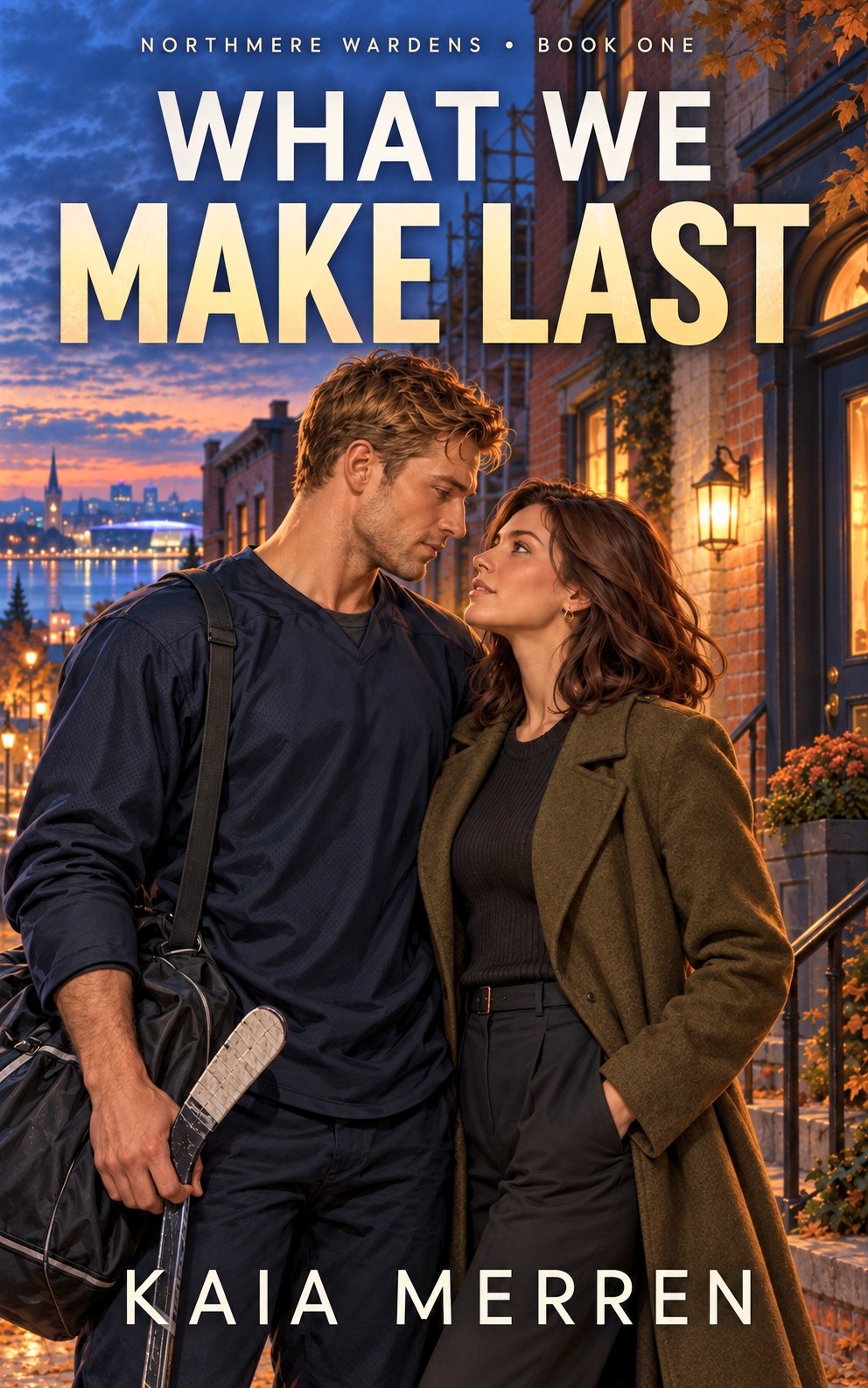
Editorial disclosure: Fiction Found Here publishes What We Make Last by Kaia Merren. It is clearly labeled below and is included because Northmere Wardens is built around top-tier professional hockey and adult career stakes.
Affiliate disclosure: As an Amazon Associate I earn from qualifying purchases. If you buy through an Amazon link in this guide, Fiction Found Here may earn a commission at no extra cost to you. Full disclosure.
Best for: readers who want a professional goalie, grumpy/sunshine energy, forced proximity, and a heroine rebuilding her own career.
The first Vancouver Storm book puts the romance inside a professional hockey organization rather than a campus. Pippa becomes goalie Jamie Streicher’s live-in assistant after her music-industry plans fall apart. The setup works because proximity is not merely romantic convenience: she is trying to figure out what comes next for her while he is operating inside the pressures of a professional season.
2. The Fake Out by Stephanie Archer
Best for: fake dating, team-staff proximity, a confident hero, and professional-team continuity.
The second Vancouver Storm book pairs physiotherapist Hazel with Rory Miller, a star player connected to her past through her ex. Their fake relationship creates both personal and workplace complications because they exist inside the same professional sports environment.
3. Mile High by Liz Tomforde
Best for: adult workplace boundaries, team travel, and a cocky professional athlete paired with a heroine who has her own job.
Mile High centers on a professional hockey player and the flight attendant working the team’s aircraft. That setup creates a different flavor from campus romance: travel schedules, professional expectations, public behavior, and a major-league season all matter.
4. Heated Rivalry by Rachel Reid
Best for: professional rivals, secrecy, long-term tension, and M/M hockey romance.
Shane Hollander and Ilya Rozanov are elite players whose rivalry is part of their public identity. Their private relationship therefore carries consequences far beyond a college rumor mill. Career image, league culture, competition, and the possibility of exposure all matter.
5. Consider Me by Becka Mack
Best for: an NHL bad-boy hero, persistent pursuit, big personalities, and a heroine who is not impressed by fame.
Carter Beckett is accustomed to attention, while Olivia Parker has a life and career outside hockey. The appeal comes from one person operating inside professional-athlete celebrity and the other refusing to organize her world around it.
6. Pucking Around by Emily Rath
Best for: why-choose romance, very high heat, and a professional hockey organization as the shared environment.
This is not a conventional one-player/one-partner sports romance. Its appeal is the larger relationship structure and the way multiple professional hockey personalities intersect with a heroine whose work brings her into their orbit.
7. Pucked by Helena Hunting
Best for: readers who want one of the established gateways into professional hockey romance.
Helena Hunting’s series helped establish many of the conventions readers now associate with hockey romance: professional players, big personalities, team continuity, humor, sex, and relationships complicated by athlete visibility.
8. The Wingman by Stephanie Archer
Best for: friends-to-lovers and professional-team found family.
This Vancouver Storm installment shifts into a friendship-based romance. Hayden is a professional defenseman, but the emotional hook is less about celebrity and more about what happens when a trusted relationship changes shape.
Best for: marriage of convenience, enemies-to-lovers energy, and a harder-edged player role.
The Vancouver Storm series keeps changing its romance mechanism while preserving the professional hockey setting. Gloves Off uses marriage-of-convenience and antagonistic chemistry.
Best for: a completed professional-team series and readers who like later-series payoff.
As a later Vancouver Storm novel, this book benefits from the accumulated sense of team community. Readers who enjoy interconnected standalones often get more value once recurring players, partners, staff, and routines begin to feel like a real organization.
Best for: readers looking for a more vulnerable, lower-glamour emotional setup around a professional hockey hero.
Professional sports romance does not have to be about red carpets and swagger. Home Game is often recommended by hockey-romance readers who want stronger caretaking dynamics and a relationship that develops outside the usual campus or fake-dating setup.
12. What We Make Last by Kaia Merren — Fiction Found Here
Best for: readers who want a top-tier professional hockey setting, a career-focused heroine, adult conflict, team continuity, and high heat.
Northmere Wardens begins with a professional franchise in Wisconsin emerging from a rebuild into a high-expectation era. The romance pairs that world with Clara Keene, a preservation architect whose own work is not decorative background. The book is designed around two adults whose jobs, schedules, obligations, and future plans all matter to the relationship.
Why professional hockey romance feels different from college hockey romance
The biggest difference is not age alone. It is consequence.
In college romance, the external pressure often comes from classes, eligibility, campus reputation, graduation, or first serious relationships. In professional hockey romance, conflict can involve contracts, trades, media attention, injuries, agents, long road trips, coaching decisions, retirement timelines, and partners whose own careers do not move neatly around a season schedule.
Frequently asked questions about professional hockey romance
What makes a hockey romance “professional” rather than college hockey?
The central athlete is playing at the professional level, so contracts, trades, roster security, travel, media attention, injuries, playoffs, retirement timelines, and adult careers can shape the relationship.
Which professional hockey romance is a good place to start?
Do I need to understand hockey to read these books?
No. The strongest books explain only the hockey details the relationship and plot require. Professional-team structures matter more than memorizing rules.
Affiliate disclosure: As an Amazon Associate I earn from qualifying purchases. If you buy through an Amazon link in this guide, Fiction Found Here may earn a commission at no extra cost to you. Full disclosure.
Hockey romance is having an unusually visible year in 2026. The success of the Heated Rivalry adaptation, renewed attention on hockey around the Winter Olympics, and the screen version of Elle Kennedy’s Off-Campus books have pushed a once-niche corner of sports romance further into the mainstream. Town & Country highlighted that convergence this year, while Publishers Weekly reported a growing appetite for the subgenre after the TV breakout.
The good news for readers is that hockey romance is not one single flavor. You can find college settings, professional teams, rivals-to-lovers, fake dating, queer romance, why-choose relationships, single dads, workplace tension, found family, and heroines with demanding careers of their own. The best hockey romance books use the sport as more than decoration: schedules, contracts, injuries, travel, public scrutiny, team culture, and career pressure all complicate the relationship.
This list is designed as a starting point rather than a popularity contest. It mixes major BookTok gateway titles, long-running genre favorites, queer hockey romance, professional-team stories, and newer 2026 releases so you can pick the book that actually matches what you want to read next.
Editorial disclosure: Fiction Found Here publishes What We Make Last by Kaia Merren. It is clearly labeled below and is included because it fits this article’s professional-hockey focus. The other recommendations are independent editorial selections.
Quick picks: the best hockey romance books for different readers
Top-tier hockey, adult professional stakes, and a career-focused heroine
12 hockey romance books worth reading
1. Icebreaker by Hannah Grace
Best for: readers who want college sports romance, a figure-skating crossover, forced proximity, and a large friend-group atmosphere.
Icebreaker became one of the defining gateway books for the current hockey-romance boom. Hannah Grace pairs competitive figure skater Anastasia Allen with hockey captain Nate Hawkins after a facilities problem forces the two teams to share a rink. The setup creates immediate friction, but the real appeal is the blend of romance, team dynamics, and the sense that both leads have athletic goals outside the relationship.
Simon & Schuster describes the novel as a TikTok sensation and notes that it has sold more than two million copies. That scale matters because it helped introduce a large new audience to hockey romance as a distinct shelf rather than simply another sports-romance setting.
Choose it if: you like campus settings, ensemble casts, athletes on both sides of the romance, and a long contemporary-romance read.
Best for: readers who want professional hockey, rivals-to-lovers, secrecy, queer romance, and career-level stakes.
If you want hockey itself to matter to the relationship, Heated Rivalry is one of the clearest choices on this list. Shane Hollander and Ilya Rozanov are elite professional players whose public rivalry is central to their identities and careers. Privately, that rivalry becomes something much more complicated.
The novel is Book 2 in Rachel Reid’s Game Changers series, but its central romance has become the franchise’s breakout story. In 2026, the TV adaptation pushed the book into a much larger cultural conversation, and Harlequin now markets the series directly around the adaptation.
Choose it if: you want the tension of public competition versus private intimacy, a relationship that develops over time, and the pressure of being visible professional athletes.
Best for: readers who want a classic college-hockey romance with tutoring, fake dating, and opposites who become genuine partners.
The Deal predates the latest BookTok hockey wave, but it remains one of the subgenre’s foundational modern titles. Hannah Wells agrees to tutor hockey captain Garrett Graham, and he agrees to help her attract someone else through a pretend-dating arrangement. Predictably, the deal does not stay pretend.
What keeps the book relevant is how efficiently the setup delivers several enduring sports-romance pleasures at once: a high-performing athlete whose career plans matter, a heroine with her own emotional history, team life, campus proximity, and a fake relationship that forces two people into honest contact.
Choose it if: you like college romance, fake dating, tutoring bargains, and an established series with multiple related books to continue into.
Best for: readers who prefer professional hockey, grumpy/sweet chemistry, live-in proximity, and adult career concerns.
Stephanie Archer’s Behind the Net moves away from the college template and into the Vancouver Storm professional-hockey world. Aspiring musician Pippa Hartley becomes the personal assistant to Jamie Streicher, the surly player she once had a crush on in high school. The job also puts her inside his home and daily life, which gives the romance a natural proximity engine.
The book works particularly well for readers who want the hero’s hockey career to coexist with the heroine’s own ambition rather than swallow it. Pippa’s music matters, Jamie’s professional life matters, and the relationship develops in the space where those priorities collide.
Choose it if: you want professional players, workplace-adjacent tension, second-chance echoes, and a romance with a warm emotional core under the grumpy exterior.
Best for: readers who want fake dating, professional hockey, revenge-adjacent setup, and a hero whose public swagger hides a softer side.
The Fake Out stays in the Vancouver Storm world but changes the romantic mechanism. Physiotherapist Hazel Hartley fake-dates star player Rory Miller, partly because he is the rival teammate of her ex. Rory was also someone she knew in high school, so the story layers old familiarity underneath the new performance.
This is an especially good pick if the appeal of hockey romance for you is the team ecosystem: staff, players, rivalries, and the blurred line between professional and personal lives.
Choose it if: you want adult characters, fake dating that quickly becomes emotionally dangerous, and a professional-team setting.
Best for: readers who want an NHL-level hero, a heroine with a real job around the team, road-trip proximity, and emotionally vulnerable adult romance.
In Mile High, Evan Zanders is a professional hockey star with a carefully managed public image, while Stevie is the new flight attendant working aboard the team’s private plane. That means the romance is built around the actual rhythms of a professional sports season: travel, road games, repeated proximity, and the gap between who an athlete appears to be publicly and who he is off camera.
Tomforde’s own background is relevant here: before writing full time, she worked as a flight attendant for an NHL team, and she has said Stevie’s job was based on her former work. That gives the book an appealing professional texture for readers tired of sports settings that feel interchangeable.
Choose it if: you want a long, character-driven romance with professional athletes, found family, body-image themes, mental-health representation, and plenty of steam.
Best for: readers who want M/M hockey romance, friends-to-lovers history, second-chance friendship, and emotional intimacy alongside the sport.
Him centers on Jamie Canning and Ryan Wesley, former best friends whose relationship fractured after a complicated night at hockey camp. Years later, their college teams are headed toward the national championship, creating an opportunity—and a problem—when they reconnect.
The hockey history is inseparable from the relationship history. Camp, competition, and the transition toward professional ambitions all function as more than background, which is why the book remains an easy recommendation for readers looking beyond the most recent viral titles.
Choose it if: you want friendship history, queer romance, hockey-camp nostalgia, and a relationship with a full sequel available afterward.
Best for: readers specifically looking for a very high-heat, why-choose/poly hockey romance.
Pucking Around is not the book to pick if you want a restrained slow burn. It is deliberately expansive, explicit, poly, kink-friendly, and built around a professional hockey organization. Rachel Price lands a sports-medicine fellowship with the Jacksonville Rays and finds herself entangled with multiple men connected to the team.
Kensington describes the book as the TikTok sensation that launched the Jacksonville Rays series, and its popularity helped broaden what readers expect hockey romance to include. It also puts Rachel’s medical career inside the team structure, which gives the central relationship network a clear professional setting rather than a random collection of athletes.
Choose it if: you actively want why-choose romance, multiple partners, professional hockey, and a long, high-heat read.
Best for: readers who want women’s hockey to matter on the page, a female athlete with serious goals, and the next generation of the Off-Campus world.
Gigi Graham is not adjacent to hockey—she is a hockey player herself. Her goals include making the women’s national team and pursuing Olympic gold, while Luke Ryder is dealing with the chaos of a newly merged men’s hockey program. Their relationship therefore develops between two characters whose competitive athletic ambitions both matter.
That makes The Graham Effect a useful counterpoint to the more common hockey-romance setup in which only the male lead plays. It also offers a bridge for readers who already know Garrett Graham from The Deal.
Choose it if: you want ambitious athletes on both sides, campus hockey, intergenerational series continuity, and a heroine whose sporting career is central.
Best for: readers who want a 2026 release with professional hockey, a single dad, brother’s-best-friend tension, and a small-business subplot.
Lauren Blakely’s Just Breaking the Rules opens the Hockey Ever After series with Corbin Knight, a professional hockey star and single father, and Mabel, who is trying to turn an inherited firehouse into her dream bakery. When financing falls through, Corbin becomes her business partner as well as the very inconvenient man she is not supposed to want.
The appeal here is the collision of two adult worlds: elite hockey and a genuinely consequential small-business launch. The book also gives readers several familiar romance hooks—brother’s best friend, workplace proximity, one-who-got-away energy, and a hero who has wanted the heroine longer than she realizes.
Choose it if: you want a fresh 2026 title with adult responsibilities, family ties, and professional hockey rather than a campus setting.
Best for: readers who want a newer M/M hockey romance, a struggling goalie, grumpy/sunshine energy, and an underdog sports arc.
Published as the fourth Hockey Guys book, My Kind of Guy follows Becker James, a once-promising goalie now riding the bench in the minors, and Forest, the bartender at the queer bar Beck visits every week. Their worlds collide more directly when Forest’s LGBTQ hockey team suddenly needs a goalie.
The setup gives the hockey plot a different texture from superstar-captain stories. Beck is not cruising through a glamorous career; he is trying to save one. That professional vulnerability makes the romance especially appealing if you prefer athletes with something real to lose.
Choose it if: you want queer hockey romance, a career slump, beer-league community, grumpy/sunshine chemistry, and a hero fighting for another chance.
Best for: readers who want top-tier professional hockey, capable adult characters, career pressure, explicit romance, and a heroine whose professional identity matters just as much as the athlete’s.
What We Make Last opens Kaia Merren’s Northmere Wardens series. The fictional Northmere Wardens are emerging from a multi-year rebuild into a high-expectation era, so hockey affects schedules, contracts, travel, leadership, and the choices the central couple can realistically make.
The series is designed around interconnected standalones: each book follows a new couple and delivers its own happily-ever-after, while the team, city, season, and recurring ensemble carry forward.
Choose it if: you specifically want adult professional sports romance rather than college hockey, with competent heroines, team found family, real career stakes, and high heat.
The easiest way to narrow the subgenre is to decide which part of hockey romance you actually want repeated.
Choose college hockey if you want proximity and first-adult-life energy
Start with Icebreaker, The Deal, or The Graham Effect. Campus hockey naturally creates shared housing, tutoring, parties, classes, team friendships, and characters still deciding what their adult lives will become.
Choose professional hockey if you want bigger external stakes
Choose queer hockey romance if secrecy, identity, or community is part of the appeal
Heated Rivalry, Him, and My Kind of Guy all approach queer hockey from different angles: superstar rivals under public scrutiny, former best friends reconnecting through hockey, and a struggling goalie finding community beyond the professional rink.
Choose why-choose hockey if you want maximum heat and relationship complexity
Pucking Around is the obvious starting point on this list. It is built for readers who actively want a poly relationship structure rather than a conventional two-person romance.
Why hockey romance works so well
Hockey gives romance writers a useful combination of physical competence, forced schedules, public pressure, and built-in community. A season creates a natural timeline. Road trips create proximity and absence. Contracts and trades create credible threats to the future. Locker rooms create recurring side characters. Injuries expose vulnerability. Playoffs raise stakes without requiring the romance itself to manufacture melodrama.
That flexibility also explains why two hockey romances can feel completely different. The Deal is fundamentally a campus bargain romance. Heated Rivalry is about elite rivals whose public identities complicate intimacy. Behind the Net uses live-in workplace proximity. Pucking Around uses the team organization to support a poly relationship. What We Make Last is built around professional careers and the practical uncertainty of a player’s future with a franchise.
The rink may be the common setting, but the romantic engine is what determines whether a book is right for you.
Frequently asked questions about hockey romance books
What is a hockey romance book?
A hockey romance is a romance novel in which hockey is central to at least one major character’s life and usually affects the plot through team culture, schedules, competition, career decisions, travel, injuries, or public attention. The strongest examples use the sport as part of the conflict rather than as interchangeable scenery.
Do you need to understand hockey to read hockey romance?
No. Most hockey romances explain the sport only as much as the story requires. If you understand that teams are competing, careers matter, and games create pressure, you can usually follow the relationship without knowing detailed rules.
Are hockey romance books usually spicy?
Many of the most visible contemporary hockey romances are open-door and explicit, but the heat level varies significantly by author and title. If explicit content is a deciding factor for you, check the author’s current content notes or retailer description before choosing.
What is the best hockey romance to start with?
For a broad introduction, Icebreaker is the obvious BookTok gateway, The Deal is a strong classic college-hockey choice, and Heated Rivalry is the standout if you want professional rivals and queer romance. Readers who specifically want adult professional-hockey settings can start with Behind the Net, Mile High, or What We Make Last.
What should I read after Icebreaker?
If you want another college setting, try The Deal or The Graham Effect. If you want to move into professional hockey, try Behind the Net, The Fake Out, or Mile High. A dedicated Books Like Icebreaker guide is coming next in Fiction Found Here’s hockey-romance cluster.
More hockey romance guides from Fiction Found Here
This article is the main hub for our hockey-romance coverage. Next, we are building deeper guides for readers looking for professional hockey romance books, books like Icebreaker, and hockey romance with strong female leads. Those narrower guides will make it easier to choose by setting, trope, and character type instead of scrolling through one giant list.
To provide the best experiences, we use technologies like cookies to store and/or access device information. Consenting to these technologies will allow us to process data such as browsing behavior or unique IDs on this site. Not consenting or withdrawing consent, may adversely affect certain features and functions.
Functional
Always active
The technical storage or access is strictly necessary for the legitimate purpose of enabling the use of a specific service explicitly requested by the subscriber or user, or for the sole purpose of carrying out the transmission of a communication over an electronic communications network.
Preferences
The technical storage or access is necessary for the legitimate purpose of storing preferences that are not requested by the subscriber or user.
Statistics
The technical storage or access that is used exclusively for statistical purposes.The technical storage or access that is used exclusively for anonymous statistical purposes. Without a subpoena, voluntary compliance on the part of your Internet Service Provider, or additional records from a third party, information stored or retrieved for this purpose alone cannot usually be used to identify you.
Marketing
The technical storage or access is required to create user profiles to send advertising, or to track the user on a website or across several websites for similar marketing purposes.